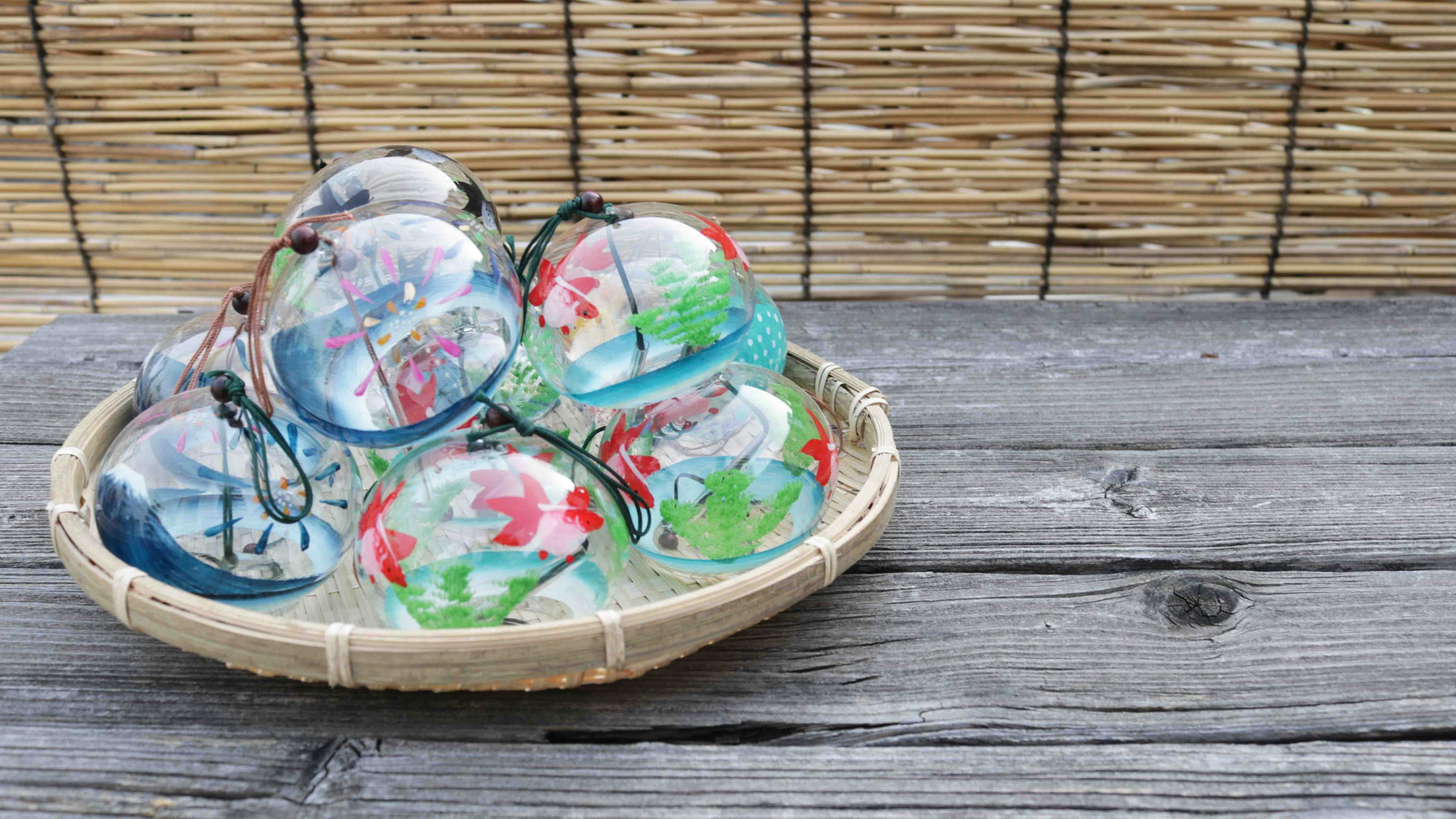
How long does it take to learn to make wind chimes good enough to sell?
How long do you have to train before you can have your own workshop?
What is difficult about making Edo Fuurin?
What made you decide to do this work?
I was born in 1956 as the second son of a family that made glass wind chimes, and from around junior high school I was made to help with the glass blowing. In junior high I was a little rebellious and did not like helping. But my father and mother both worked so hard that I helped out when I came home from school, and on Sundays when there were no club activities. Thanks to that, I was able to go all the way to university.
Helping with the family business leads to the family's prosperity, and that is a wonderful thing. After graduating I wanted to do a different kind of work, but after a while at a company I could no longer see the future I had imagined, so I quit to start over (after 10 months). At the time, my older brother had taken over our family business (Shinohara Fuurin Honpo) and was extremely busy, so I decided to help. I worked without a salary until I was 30. I did get pocket money, though — and I feel like I spent more of it than I would have of a salary!
We are a family that works hard from early morning until late at night (with no days off). As we kept making wind chimes, our work changed little by little. At first we made only wind chimes for the Hozuki-ichi (Ground Cherry Fair) in Asakusa, but then wholesale orders from folk craft shops increased, and before long department stores began holding craftsman exhibitions as cultural events. We needed to make many different types.
Around this time I had the chance to rethink our family's products, and I began to hope I could spend my whole life in this work. It does not make much money, but if you keep at it steadily, things will work out! Japan has four seasons, and those who came before us made the Edo Fuurin (glass wind chime) into what is called a "summer tradition." What remains is to see how far my own skills can go.
One day, in a TV interview, my father Yoshiharu announced, "To counter complaints about wind chime noise, I am thinking of making wind chime earrings" (around April 1984). My brother (Yutaka) and I looked at each other as if to say, "What do we do now?" My father liked to go on the offensive in his work. I thought something that small would be impossible with our skills at the time, and that people would never accept wearing wind chimes on their ears.
Life is interesting, though. In July that year we were able to exhibit at a Japan Fair in Rotterdam, the Netherlands, where we met and became friends with Mr. Osada, then the most skilled tatami maker in the Kanto region. He told me that something unusual was selling well: all kinds of people were buying one-meter lengths of tatami edging. The next day, I was surprised to see a young woman at the venue wearing tatami edging around her waist. And in a department store window, there were chopsticks stuck in a mannequin's hair. "Amazing — if it is good, anything goes!"
After a month at the fair in Rotterdam, I returned to Japan, and at the end of August I made small wind chimes and turned them into earrings (about the size of a big toe). In early September we had a TV interview, and the announcer said, "I know someone at a newspaper, so I will introduce these," and she did. In September they were featured in the national edition of the Yomiuri Shimbun, and we received many inquiries asking, "Where can I buy them?" (We received 3,000 postcards — and replied to them.) The first earrings were a little large and were the best we could manage at the time. I still remember talking at length on the phone with the newspaper's commentator.
From around then, I began to gain some confidence in making Edo Fuurin. I think that was when I became sure I wanted to do this work with my family.
P.S. Looking back now, we were lucky, too.
When were they named "Edo Fuurin"?
Why are they called "fuurin"? Where does the name come from?
What makes Edo Fuurin special?
How do you use them?
However, with the spread of aluminum sash windows, modern buildings no longer have eaves. As a result, more and more people hang them on balconies or laundry poles, or indoors so as not to bother their neighbors, for example on a stand. (Most households use air conditioning in summer. If you live with the windows shut, who will enjoy the sound of a wind chime hung outside?) It has become a lonely era.
*The fukin made in the Edo period were very expensive rarities. Naturally, they were hung indoors and admired. (They were not just for summer.)
What is good about Edo Fuurin?
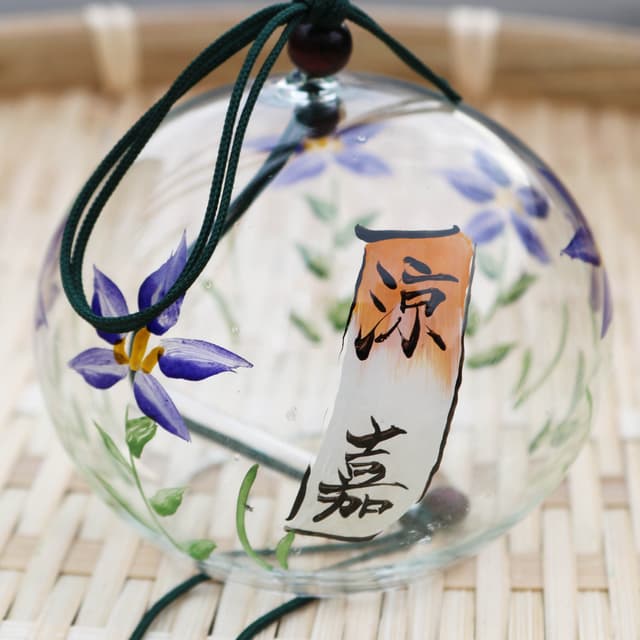
Because the pictures are painted on the inside, they are very beautiful. The basic idea of the sound: a sound you can nap to — on a hot summer day, open all the windows and take a nap to the gentle tone of an Edo Fuurin.
*Napping to the sound of an Edo Fuurin is the best.
Are there designs unique to Edo Fuurin, or particular features of the designs used?
How do Edo Fuurin today differ from the past in terms of methods, tools, materials, and traditions?
Glass wind chimes, once luxury items ordinary people could not obtain, became something for everyone. Rarities once hung inside houses came to be hung from the eaves, and later on balconies. Recently, somewhat finer wind chimes have appeared, and they are being displayed indoors again (because many homes have nowhere to hang them outside).
The name also changed from "fukin" to "fūrei," then to "fūrin," and finally my father, Yoshiharu Shinohara, renamed them "Edo Fuurin."
With Edo Fuurin, do men make the glass and women paint the pictures?
Painting, which is done sitting down, may suit women better. But at Maruyoshi, we do both. Every finished wind chime is made by Maruyoshi. At Maruyoshi Fuurin, attaching the strings, packing, and shipping are the job of the women (the okami, or proprietress). This is also a very important job for the finished products.
Why do the prices differ?
How did you survive the Great Kanto Earthquake and World War II and keep producing?
Until around 1945, when World War II ended, there were about five or six places in Tokyo making glass wind chimes. At that time, my ancestors made glass products in two teams: a free-blowing team that made wind chimes as summer approached and Christmas ornaments as winter approached, and a molding team that made ashtrays (Showa era), ink stands (Showa era), lamp chimneys (Taisho era), medicine bottles, and fuel bottles for oil lighters (postwar).
Demand for everyday goods kept the glass workshop going. My father (Yoshiharu) said they made many oil lighter bottles after the war and earned quite a lot from them.
From around 1955, we began to specialize in glass wind chimes, as glass bottles gave way to plastic and ink stands were no longer needed once fountain pens became common. Later, our glass wind chimes were named Edo Fuurin. By then, only the Shinohara family was making Edo Fuurin. We sold what we made at the Hozuki-ichi (Ground Cherry Fair) in Asakusa and to wholesalers of good-luck charms. The Hozuki-ichi in Asakusa is one of the essential reasons glass wind chimes survived in Tokyo.
I think it was because we had the skills to create products that would sell without much investment, and because the big festivals were revived.