Where to Hang Your Edo Fuurin
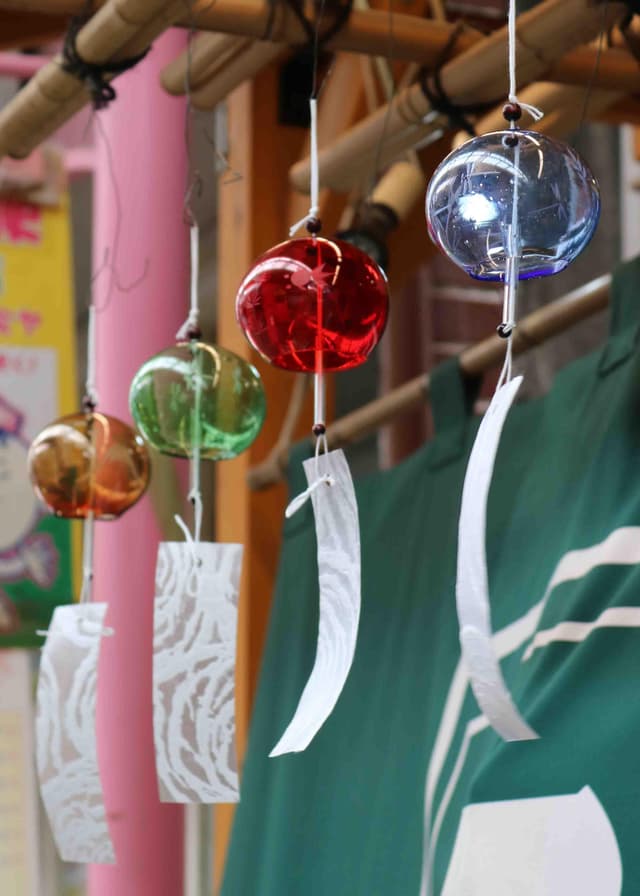
Until fairly recently, it was common to hang wind chimes under the eaves — the eaves of the ground floor, that is. On a balcony on the second floor or higher, the wind is stronger and the chime will ring all day long. The charm of a wind chime is that it rings only now and then, which is why it is loved in the hot summer, when there is little wind.
Most modern houses have no eaves. It would be nice if every home were a traditional old house, but that is not the case. Many people also live in apartments or in houses built close together, and some have been asked by neighbors to stop because of the noise, so there are fewer and fewer places to hang wind chimes outdoors. Still, in Japan, seeing a wind chime makes people want to hang one at home, because we have a custom of enjoying the atmosphere of the season and appreciating sound.
These days, most people hang their wind chimes indoors. However, the only place to hang them is often something like a curtain rail. That is why we also recommend attaching a special hook to the wall. Hanging a wind chime on a stand to enjoy its atmosphere is another good option.
If Your Wind Chime Breaks
Many Edo Fuurin carry auspicious meanings, so it can be quite a shock when one breaks. But don't worry — it took the misfortune in place of your family. Please dispose of it on non-burnable garbage day with a feeling of thanks.
Repairing the String or Glass Tube
As long as the body of the wind chime is not damaged, we can replace an old string for about ¥150. If you are interested, please contact us by email or phone. We are grateful to everyone who takes good care of their wind chimes.
How to Choose a Wind Chime
Written by: Michihiro Shinohara
When you want an Edo Fuurin for your home, there are so many kinds that it is hard to decide. So here are some points to consider, from a craftsman's point of view:
• ① Choosing by sound
• ② Choosing by the meaning of the design
• ③ Choosing a design you like
• ④ Which ones make good gifts?
I will go through them in this order, so if you would like to buy a wind chime but cannot decide which one, please read on.
① Choosing by Sound
How to choose the sound
Let me start with ①. With a wind chime, the sound matters most. Without getting too technical, the sound of a wind chime is said to have "1/f fluctuation," a pattern that people find pleasant. In nature, you hear it in the murmur of a stream, birdsong, and waves rolling in and out — just thinking of them makes you feel calm.
Each Edo Fuurin is made individually by free-blowing, so every one sounds different. Naturally, the pitch varies from low to high.
Now and then, customers with perfect pitch choose one by saying, "I think an F would be nice."
Personally, rather than judging by pitch, I think the best choice is "the sound that relaxes you most when you hear it at that moment."
It is an intuitive answer, but tastes in sound change quite easily, so I recommend listening carefully and choosing one that suits how you feel right now.
Just in case, here is a note on preferences by pitch:
• Higher: feels energizing; tends to be preferred by younger people
• Lower: feels calming; preferred by people who are always on the go and a little tired
This is a rough generalization, but it is the tendency I have noticed, so I hope it helps. If you have any questions when you visit the shop, please feel free to ask.
Each Edo Fuurin is made individually by free-blowing, so every one sounds different. Naturally, the pitch varies from low to high.
Now and then, customers with perfect pitch choose one by saying, "I think an F would be nice."
Choose the one that relaxes you
Personally, rather than judging by pitch, I think the best choice is "the sound that relaxes you most when you hear it at that moment."
It is an intuitive answer, but tastes in sound change quite easily, so I recommend listening carefully and choosing one that suits how you feel right now.
Just in case, here is a note on preferences by pitch:
• Higher: feels energizing; tends to be preferred by younger people
• Lower: feels calming; preferred by people who are always on the go and a little tired
This is a rough generalization, but it is the tendency I have noticed, so I hope it helps. If you have any questions when you visit the shop, please feel free to ask.
② Considering the Meaning
The Japanese and their gods
The goldfish is one of the most typical designs on wind chimes, and it has a very auspicious meaning: "bringing in money." As introduced on our product page, every design has its own meaning.
Since ancient times, the Japanese have cherished the idea of "yaoyorozu no kami" (the eight million gods): gods dwell in everything in nature, from mountains, seas, and rocks to all kinds of animals. Hayao Miyazaki's "Spirited Away," for example, is set in a bathhouse in another world where these countless gods come to relax.
Nature gives people blessings, but it also has frightening sides that can harm life, such as earthquakes, storms, and epidemics. Out of awe for nature, the Japanese have long built shrines and revered the gods, asking them to calm their "anger" and grant their "blessings."
From this way of thinking, the Japanese created "yokai" (supernatural creatures) and "engimono" (good-luck charms) based on familiar animals, and have long held "events" such as fireworks and festivals to ward off disasters and pray for good harvests.
That was a long introduction, but it is from this way of thinking that we, too, paint auspicious designs on our wind chimes.
For example, if you run a business and want better financial luck, we recommend goldfish or maneki-neko (beckoning cat) designs. If you want your hard work to pay off, we recommend the dragonfly, known as the "victory insect," or designs with Mount Fuji, whose widening slopes symbolize growing prosperity.
Recently, with the spread of COVID-19, Amabie has also been drawing attention. In the Edo period and earlier, there was no hope of vaccines or other cures, so once a terrible disease spread, things were far harsher than today. Perhaps it was out of such wishes that the legend arose of Amabie appearing from the sea and saying that showing its picture would cure the epidemic.
Fireworks and red wind chimes also carry the meaning of warding off evil, so we recommend them too.
There are many other wind chimes with all kinds of meanings, so please take a look at our product page and choose one that suits you.
Since ancient times, the Japanese have cherished the idea of "yaoyorozu no kami" (the eight million gods): gods dwell in everything in nature, from mountains, seas, and rocks to all kinds of animals. Hayao Miyazaki's "Spirited Away," for example, is set in a bathhouse in another world where these countless gods come to relax.
Nature gives people blessings, but it also has frightening sides that can harm life, such as earthquakes, storms, and epidemics. Out of awe for nature, the Japanese have long built shrines and revered the gods, asking them to calm their "anger" and grant their "blessings."
From this way of thinking, the Japanese created "yokai" (supernatural creatures) and "engimono" (good-luck charms) based on familiar animals, and have long held "events" such as fireworks and festivals to ward off disasters and pray for good harvests.
Knowing the meaning of designs
That was a long introduction, but it is from this way of thinking that we, too, paint auspicious designs on our wind chimes.
For example, if you run a business and want better financial luck, we recommend goldfish or maneki-neko (beckoning cat) designs. If you want your hard work to pay off, we recommend the dragonfly, known as the "victory insect," or designs with Mount Fuji, whose widening slopes symbolize growing prosperity.
Recently, with the spread of COVID-19, Amabie has also been drawing attention. In the Edo period and earlier, there was no hope of vaccines or other cures, so once a terrible disease spread, things were far harsher than today. Perhaps it was out of such wishes that the legend arose of Amabie appearing from the sea and saying that showing its picture would cure the epidemic.
Fireworks and red wind chimes also carry the meaning of warding off evil, so we recommend them too.
There are many other wind chimes with all kinds of meanings, so please take a look at our product page and choose one that suits you.
③ Choosing by Your Own Taste
Choose what feels right to you
Edo Fuurin come in many designs, and each has a meaning. Still, I think it is also good to simply trust your own feelings — choosing one that soothes you on display, or that cheers you up when you look at it.
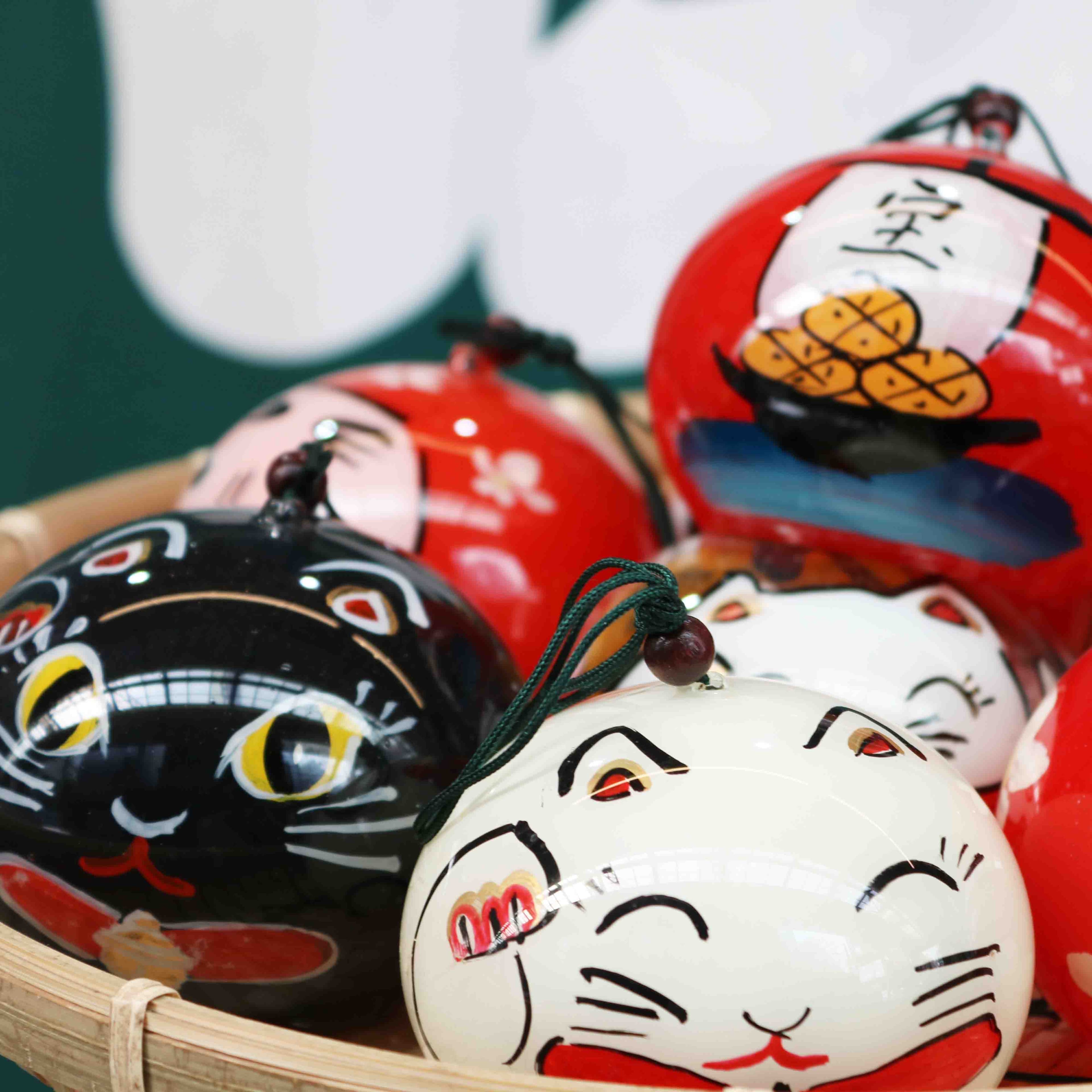
At Maruyoshi Fuurin, many of our designs feature animals, such as cats, kingfishers, whale sharks, red pandas, and frogs.
Whale sharks and red pandas in particular are rarely seen on wind chimes, so I recommend them. If you choose based on the feeling of "I would love to have this in my room," I do not think you will regret it.
④ Choosing a Gift
As a summer gift
Since few places sell Edo Fuurin, many people choose ours as summer gifts, and we are very grateful for that.
We are often asked what makes a good gift. If you know that the recipient likes, say, dragonflies or frogs, the choice is easy, but it is hard to guess someone's taste in designs.
What we recommend is:
• Thinking about the recipient's situation
• Choosing a popular design that anyone would be happy to receive
With the first approach, as mentioned in ②, you think about the recipient's current situation and give a design with a matching meaning: a maneki-neko for someone who runs a business, Mount Fuji or a black goldfish for someone working hard, or Amabie for someone worried about COVID-19. This way you do not have to fuss over the design itself, which I think makes it easier to choose.
Even so, some people may still be unsure. For them, we recommend "Three Goldfish," "Fireworks," "Mount Fuji and Fireworks," and "Kiriko (cut glass)" wind chimes.
The Three Goldfish design is the classic wind chime pattern and our most popular. It is painted in three summery colors: red, green, and blue. It is reasonably priced for an Edo Fuurin, the picture is cute, and it also stands for financial luck, so I recommend it.
The Fireworks design is another good choice. Fireworks are a summer tradition, but they also have sacred meanings: they ward off evil and are set off to console the souls of war victims. The colors are bright and the design is simple, so we highly recommend it.
The Mount Fuji and Fireworks design has also become very popular recently. It was designed around the idea of enjoying a fireworks display against Mount Fuji, and its appeal is that the picture looks harmonious from any angle. The calm colors center on navy blue, so it also suits those who prefer something a little more grown-up.
Finally, I also recommend the Kiriko wind chimes. They cost a little more than the others, but the colors are beautiful, and the faintly emerging goldfish and dragonflies are lovely.
They suit any room, and we recommend them as wind chimes with a touch of luxury.
All our other designs are recommended too, but as gifts, I would suggest the four above.
We are often asked what makes a good gift. If you know that the recipient likes, say, dragonflies or frogs, the choice is easy, but it is hard to guess someone's taste in designs.
What we recommend is:
• Thinking about the recipient's situation
• Choosing a popular design that anyone would be happy to receive
With the first approach, as mentioned in ②, you think about the recipient's current situation and give a design with a matching meaning: a maneki-neko for someone who runs a business, Mount Fuji or a black goldfish for someone working hard, or Amabie for someone worried about COVID-19. This way you do not have to fuss over the design itself, which I think makes it easier to choose.
Popular designs
Even so, some people may still be unsure. For them, we recommend "Three Goldfish," "Fireworks," "Mount Fuji and Fireworks," and "Kiriko (cut glass)" wind chimes.
The Three Goldfish design is the classic wind chime pattern and our most popular. It is painted in three summery colors: red, green, and blue. It is reasonably priced for an Edo Fuurin, the picture is cute, and it also stands for financial luck, so I recommend it.
The Fireworks design is another good choice. Fireworks are a summer tradition, but they also have sacred meanings: they ward off evil and are set off to console the souls of war victims. The colors are bright and the design is simple, so we highly recommend it.
The Mount Fuji and Fireworks design has also become very popular recently. It was designed around the idea of enjoying a fireworks display against Mount Fuji, and its appeal is that the picture looks harmonious from any angle. The calm colors center on navy blue, so it also suits those who prefer something a little more grown-up.
Finally, I also recommend the Kiriko wind chimes. They cost a little more than the others, but the colors are beautiful, and the faintly emerging goldfish and dragonflies are lovely.
They suit any room, and we recommend them as wind chimes with a touch of luxury.
All our other designs are recommended too, but as gifts, I would suggest the four above.
In Closing
Thank you for reading this far.
I wrote this article based on what I have learned from serving customers. In the end, choosing a wind chime is a matter of personal taste, but I hope this helps.
I wrote this article based on what I have learned from serving customers. In the end, choosing a wind chime is a matter of personal taste, but I hope this helps.